If you’ve ever dealt with a nagging tendon or ligament issue, you may have noticed something surprising:
the pain actually feels better after a moderate weight training session.
At first glance, this seems backward. Shouldn’t rest make injuries feel better?
Not always.
In many cases, pain reduction after training is a signal that your body is responding positively to the right kind of load—not a sign that the injury is gone, but that healing is moving in the right direction.
Understanding this distinction can help you train smarter, recover faster, and avoid turning minor issues into chronic injuries.
Pain That Improves With Movement: What It Usually Means
When pain subsides during or after a moderate workout, it often points to tendon or ligament-related discomfort, rather than acute tissue damage.
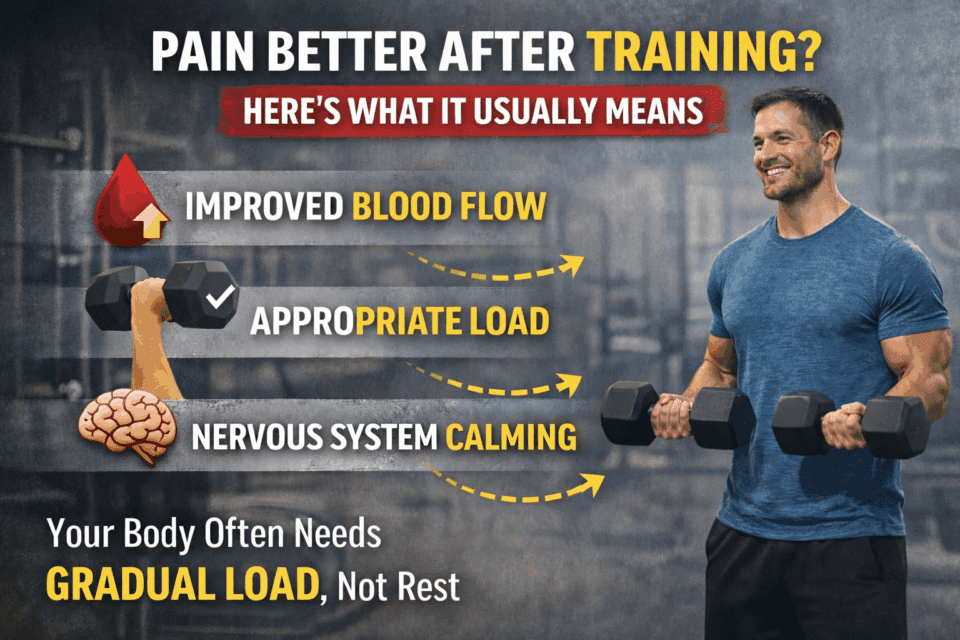
1. Increased Blood Flow and Tissue Warm-Up
Tendons and ligaments have limited blood supply. Controlled resistance training:
- Improves circulation
- Increases tissue temperature
- Reduces stiffness and joint friction
This can lead to temporary pain relief, especially in the early or mid-stages of tendinopathy.
2. The Tissue Can Tolerate Load
Pain reduction during training often means:
- The load was appropriate
- The movement pattern was controlled
- The tissue is not being overloaded
From a rehab perspective, this is considered a positive pain response.
Pain that improves with controlled movement usually reflects under-loading, not damage.
3. Nervous System Desensitization
Pain is not only a tissue issue—it’s also a nervous system response.
Moderate resistance training can:
- Reduce protective muscle guarding
- Improve motor control
- Calm overactive pain signaling
As confidence and coordination improve, the body becomes less reactive to previously painful movements.
4. Isometric and Slow-Tempo Loading Effects
Many moderate workouts naturally include:
- Isometric holds
- Slow eccentrics (controlled lowering)
- Time under tension
These loading styles are well-known for their ability to reduce tendon pain, sometimes for hours afterward.
When This Is a Good Sign
Pain relief after training is generally positive when:
- Pain stays 3/10 or lower
- Pain decreases during or after the session
- There is no increase in swelling
- The area feels the same or better the next day
- Daily activities are easier, not harder
This usually means the tissue is being stimulated—not irritated.
When to Be Cautious
Pain relief alone does not mean you should push harder.
Be cautious if:
- Pain rebounds later that day
- Pain is worse the next morning
- Swelling or joint instability appears
- Pain relief lasts only minutes, then spikes
These signs suggest the load may still be too aggressive or progressed too quickly.
How to Train When Pain Improves After Workouts
Keep the Load Consistent
If pain improves, resist the urge to immediately increase weight.
- Hold the same load for 1–2 weeks
- Progress volume before intensity
- Focus on controlled tempo
Use the “Next-Day Rule”
Ask yourself the morning after training:
“Does this feel the same or better than yesterday?”
- Yes → continue
- No → reduce load by 10–20%
Prioritize Movement Quality
Clean reps, proper range of motion, and stable joints matter more than weight on the bar—especially during healing.
Why Rest Alone Often Fails
Complete rest may reduce pain temporarily, but it often:
- Weakens connective tissue
- Reduces load tolerance
- Makes flare-ups more likely when activity resumes
Tendons and ligaments need progressive stress to heal—just not reckless stress.
The Bigger Picture
Pain that improves with moderate training is often your body saying:
“I need movement, structure, and consistency—not avoidance.”
This is especially common in people who:
- Sit frequently
- Under-load joints for long periods
- Then spike activity levels suddenly
The solution isn’t fear—it’s intentional, progressive training.
Final Takeaway
If pain subsides after a moderate weight training workout, it’s usually a sign that:
- You’re loading the tissue appropriately
- Your nervous system is calming
- Healing is being supported—not delayed
The key is patience, consistency, and respecting recovery signals.
Train to build resilience, not just strength.
