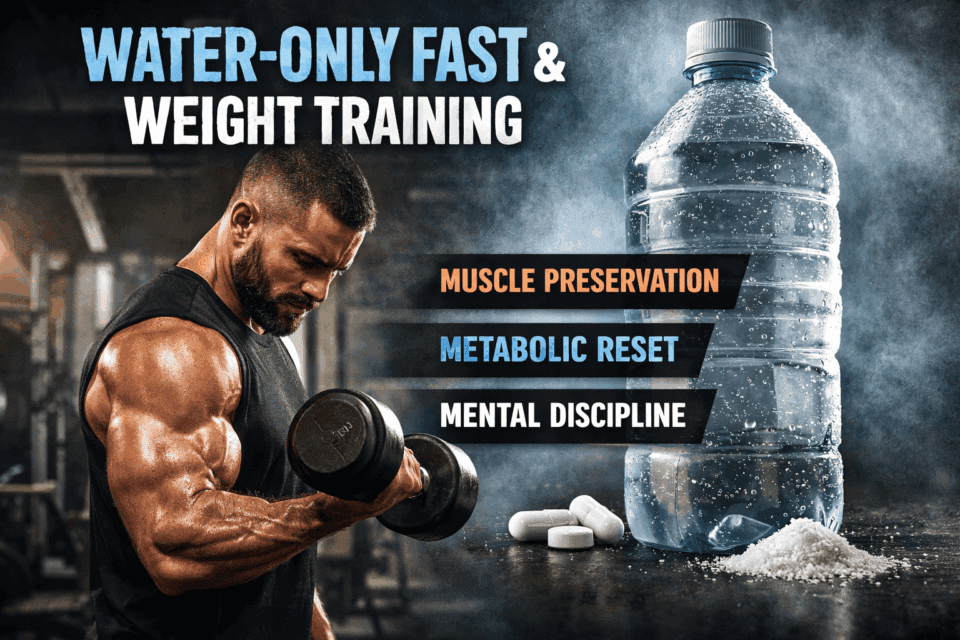
Fasting has been practiced for centuries for clarity, discipline, and renewal. In modern fitness culture, water-only fasting has re-emerged as a tool—not for rapid fat loss or muscle gain—but for metabolic reset, mental resilience, and restored body awareness.
Important positioning:
This approach is not designed to build muscle or accelerate fat loss. It is a short-term metabolic and mental reset tool intended for disciplined, experienced individuals who already have an established relationship with training, nutrition, and recovery.
When used intentionally and responsibly, pairing a brief water-only fast with light-to-moderate weight training can provide unique physical and psychological benefits—without chasing extremes.
What Is a Full Food, Water-Only Fast?
A water-only fast means no caloric intake for a defined period, typically 24–72 hours for fitness-focused individuals. During this time, the body transitions away from constant digestion and toward internal regulation and fuel efficiency.
For clarity:
- No food
- No calories
- Water consumption only
- Some individuals include non-caloric electrolytes (such as sodium) to maintain hydration and nerve function
Longer fasts should only be attempted under medical supervision.
Why Combine Fasting with Weight Training?
When weight training is maintained during a fast, the goal is not progression. Instead, training serves as a signal—a reminder to the body that muscle tissue remains necessary.
The purpose becomes:
- Neuromuscular engagement
- Strength maintenance
- Metabolic signaling
- Mental discipline
This is training stripped to its essence.
1. Improved Insulin Sensitivity and Metabolic Flexibility
Fasting lowers circulating insulin levels and encourages the body to rely more heavily on stored fat and internal fuel sources. This improves metabolic flexibility—the ability to switch efficiently between carbohydrates and fat for energy.
Light-to-moderate resistance training during a fast:
- Encourages glucose uptake without insulin spikes
- Reinforces insulin sensitivity
- Helps prevent metabolic stagnation
For individuals coming off long periods of constant eating or caloric surplus, this can act as a meaningful reset.
2. Muscle Preservation Through Mechanical Tension
Short-term fasting does not automatically result in muscle loss. In fact, mechanical tension from resistance training helps preserve muscle tissue during brief fasting periods.
Here’s why:
- Mechanical tension stimulates anabolic signaling pathways (including mTOR)
- Neuromuscular activation reduces muscle protein breakdown
- The body prioritizes muscle preservation when demand remains present
The emphasis is tension, not exhaustion.
Key Takeaway:
Muscle is preserved through intentional use—not excessive volume or intensity.
3. Enhanced Mental Discipline and Focus
Training while fasted removes comfort, stimulation, and external reward. There is no pre-workout, no post-workout meal, and no dopamine hit from food.
What remains is discipline.
Many report:
- Increased mental clarity
- Stronger mind-body awareness
- Heightened focus on form and breathing
- Reduced emotional reliance on food
This mental sharpening often becomes the most valuable outcome of the fast.
4. Autophagy and Cellular Efficiency
Fasting activates autophagy, the body’s internal cleanup process that removes damaged cells and recycles components for efficiency.
While resistance training does not directly cause autophagy, it may help:
- Direct recycled nutrients toward muscle tissue
- Improve cellular efficiency
- Support long-term tissue health
This creates a unique balance: cellular cleanup without structural loss.
5. Breaking Plateaus and Resetting Habits
For those stuck in cycles of:
- Constant bulking and cutting
- Emotional or stress-based eating
- Over-reliance on supplements
- Chronic overconsumption
A short water-only fast with disciplined training can interrupt patterns and restore control.
This approach reinforces:
- Strength without excess
- Control over impulse
- Discipline as a trainable skill
How to Train While Water Fasting (Responsibly)
This is not the time to chase PRs.
General training guidelines during a fast:
- 2–3 training sessions total
- 3–5 compound movements per session
- 2–4 sets per movement
- Moderate loads (RPE 6–7, reps left in reserve)
- Sessions kept to 20–40 minutes
- No failure training
The objective is maintenance and signaling, not adaptation.
⚠️ SAFE-USE BOX: READ BEFORE ATTEMPTING
Stop the fast and training immediately if you experience:
- Dizziness or lightheadedness during movement
- Heart palpitations
- Extreme fatigue or weakness
- Confusion, coordination issues, or tunnel vision
Do NOT attempt a water-only fast with training if you:
- Have a history of eating disorders
- Are underweight
- Have diabetes or blood sugar disorders
- Are pregnant or breastfeeding
- Are recovering from illness or injury
Fasting is a tool, not a test of toughness.
Refeeding: Where Results Are Made or Lost
How you break the fast determines whether benefits are reinforced or undone.
A proper refeed should:
- Prioritize protein
- Include whole, easily digestible foods
- Avoid binge-style eating
- Gradually reintroduce calories
Refeeding is an act of discipline—not indulgence.
Final Thoughts: Strength Under Constraint
A full food, water-only fast combined with intentional weight training is not about extremes, punishment, or aesthetics.
It is about:
- Discipline over impulse
- Stewardship of the body
- Strength under constraint
- Learning what your body truly needs
Used sparingly and responsibly, this approach can recalibrate both body and mind.
Strength isn’t always built by adding more.
Sometimes, it’s revealed by what you can temporarily do without.
Legal Disclaimer
This article is for educational and informational purposes only and is not intended as medical advice. Fasting and exercise carry inherent risks and may not be appropriate for all individuals. Always consult with a qualified healthcare professional before beginning any fasting protocol, dietary change, or exercise program—especially if you have underlying medical conditions or are taking medications. The author and MooseFit assume no responsibility for injury, illness, or adverse outcomes resulting from the use or misuse of this information.
